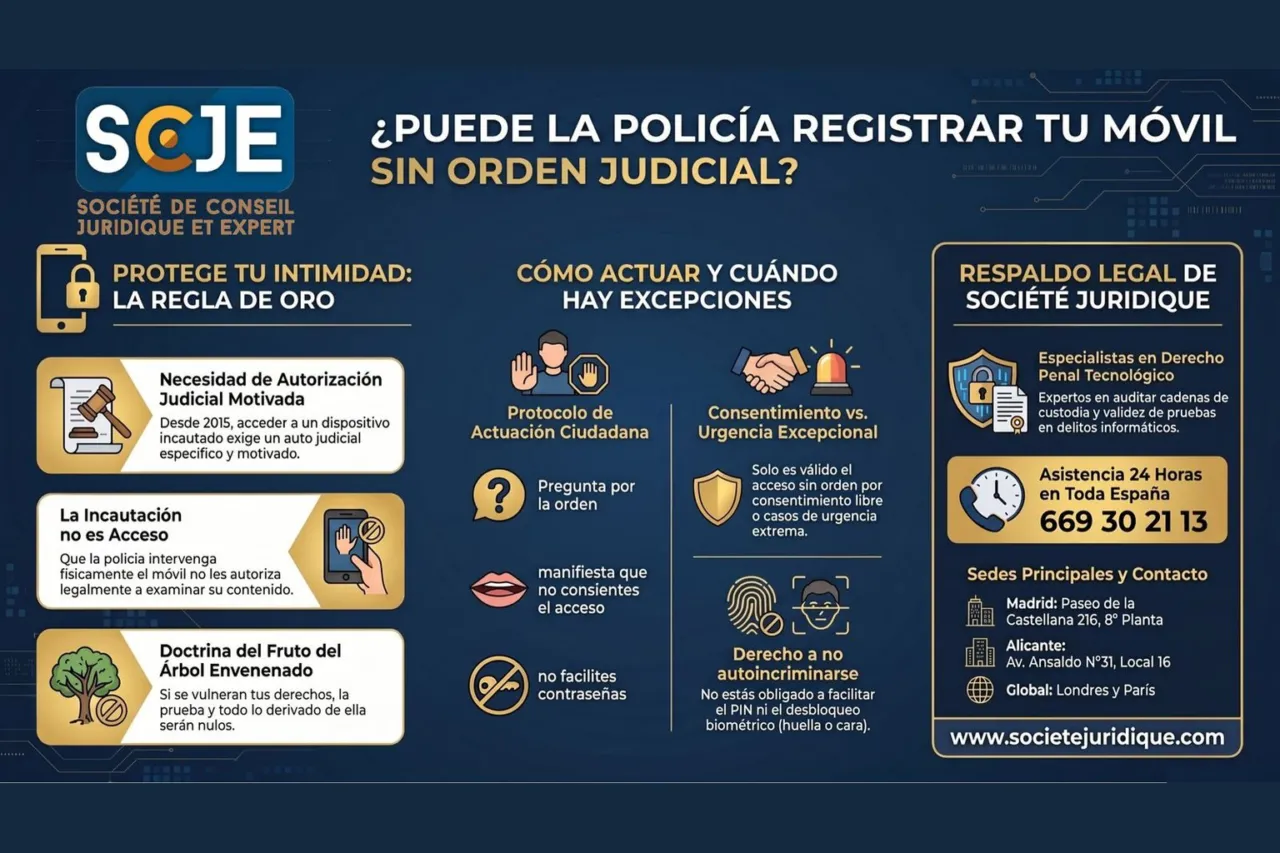
As a general rule, no: the contents of your phone are protected and searching them requires judicial authorisation. A mobile phone concentrates communications, locations, photographs and an entire private life, which is why Spanish law treats it with reinforced guarantees. Knowing them is essential, because evidence obtained in breach of them may be void, and may drag down everything derived from it.
The rule: a reasoned court authorisation
Since the 2015 reform, the Spanish Criminal Procedure Act (LECrim) regulates the search of mass storage devices (Articles 588 sexies a et seq.): access to the information held in a seized computer or telephone requires a specific court authorisation stating why, for what purpose and to what extent. Importantly, the fact that the device was lawfully seized (for example, during an arrest) does not in itself authorise examining its contents; that second authorisation is required.
The exceptions
Consent of the owner. If you voluntarily unlock the device, the examination is valid. The consent must be free and informed, and you are not obliged to give it, nor to provide passwords or your fingerprint: your right not to incriminate yourself applies.
Exceptional urgency. The police may examine the device without an order in cases of urgency involving a legitimate constitutional interest, informing the judge immediately; the judge must confirm or revoke the action within a maximum of seventy-two hours. If the judge revokes it, the evidence falls.
What to do if the police ask for your phone
Ask whether a court authorisation exists and ask to see it; state expressly that you do not consent to access if there is none; do not voluntarily provide the PIN or biometric unlocking if you do not wish to consent; and inform your lawyer of the situation as soon as possible. Do not offer physical resistance: the correct route is a subsequent challenge, in which the defence can request that the evidence, and everything derived from it, be declared void (the fruit of the poisonous tree doctrine).
Why it matters so much in technology-related offences
In cases of online fraud, cybercrime or drug trafficking, most of the prosecution case usually comes from the analysis of devices. Auditing the chain of custody, the scope of the data extraction and the regularity of the authorisations is one of the most effective lines of defence. It is the work of our technology crime team and forensic laboratory.
What the court order must contain
The authorisation to search a device is not a blank cheque. The order must identify the device, state the offence under investigation and the reasons why the examination is necessary and proportionate, and define its scope: which categories of data may be examined (messages, images, location data, cloud accounts linked to the device) and for what period. The judge may also decide whether the examination extends to data stored on remote servers accessible from the device, a point that must be expressly addressed. An order that simply authorises “the analysis of the telephone” without limits invites a challenge, because the constitutional protection of privacy and of the secrecy of communications requires that the interference be individualised.
What the defence checks in the extraction
Once the extraction has been carried out, the defence examines four elements. First, the timeline: the date and time of the seizure, of the court order and of the extraction, since an analysis performed before the authorisation is void. Second, the technique: whether a forensic copy was made with a hash value calculated at the time and recorded in the minutes, so that any later alteration can be detected. Third, the scope: whether the report contains data outside the categories or the period authorised by the judge. Fourth, the chain of custody: who had the device, where it was kept and whether the seals were intact. A defect in any of these elements is the basis for requesting the exclusion of the evidence, and often of the whole prosecution case built on it.
The rights of the person during the seizure
At the time of seizure, the person may request that the minutes record the state of the device (switched on or off, locked or unlocked) and their express refusal to consent to access. They are not obliged to reveal a PIN, a pattern or a password, nor to place a finger or face on the sensor; the right not to incriminate oneself covers active cooperation in unlocking. If the police unlock the device by technical means, that must be documented and covered by the court order. A foreign national is entitled to an interpreter during these steps and to the communication of the seizure to their lawyer, under Article 520 of the Criminal Procedure Act, whenever the seizure takes place in the context of an arrest.
Frequently asked questions
Can I be forced to use my fingerprint to unlock the phone?
You cannot be compelled to actively cooperate in your own incrimination. Any forced access without judicial cover can be challenged.
Can the police look at my phone during a routine check?
No. Outside the legal cases (authorisation, consent, exceptional urgency), the contents of the phone may not be examined.
What happens if the police exceed what the judge authorised?
The search must keep to the scope of the court order. Findings outside that scope raise validity problems and may be excluded from the proceedings.
Can the judge authorise access to my cloud accounts through the phone?
Only if the order expressly covers data stored on remote servers accessible from the device; otherwise the examination must be limited to the device itself.
What is the hash value and why does it matter?
It is a digital fingerprint of the forensic copy, calculated at the time of extraction and recorded in the minutes. If the data are later altered, the hash no longer matches, which allows the defence to detect any manipulation.
Related guides
- Interception of communications in Spanish criminal proceedings
- Chain of custody of evidence in Spain
- 24-hour criminal lawyer in Madrid
Do you need a criminal defence lawyer in Alicante or Madrid now? Société Juridique provides emergency assistance and 24-hour assistance to detained persons in Alicante, Madrid and throughout Spain.
This article is informative in nature and does not constitute legal advice. For a specific case, consult a lawyer.
Francisco Javier Martín Porras
Abogado penalista, socio de Société de Conseil Juridique et Expert y creador de la metodología LIWARD®. Dirige la defensa en procedimientos penales de alta complejidad, combinando estrategia procesal con análisis pericial y forense. Conozca al equipo →