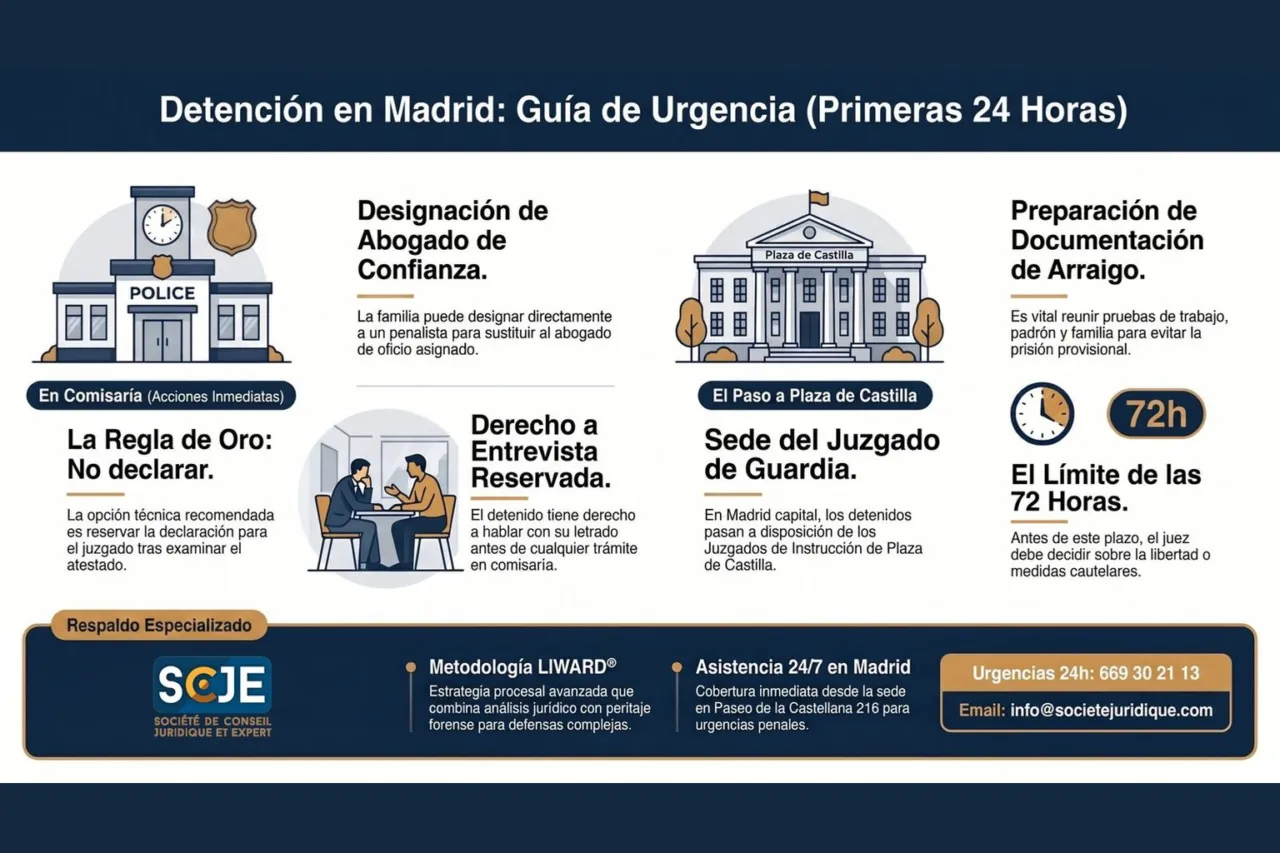
If a relative has been arrested in Madrid, what is done in the first twenty-four hours conditions the entire proceedings. Police custody may last up to seventy-two hours before the person is brought before the judge, but the critical decisions, whether to make a statement, with which lawyer and with what strategy, are taken much earlier.
The rights of the detained person (Article 520 LECrim)
The right to remain silent and not to plead guilty; to a lawyer of their choice, since there is no obligation to keep the duty lawyer; to a private interview with their lawyer before making a statement; to have the arrest communicated to a relative; to an interpreter; and to medical assistance. The family may appoint a lawyer of their choice directly: it is enough to inform the police station for the change to take effect.
The golden rule: nothing is improvised at the police station
The police statement is not a formality: what is said there will weigh throughout the proceedings. Using the rights well, deciding whether to make a statement, what to say and when, requires knowing the police report, the strength of the evidence and the subsequent strategy. In most cases, the technical option is not to make a statement at the police station and to reserve the statement for the court, once the file has been examined.
Plaza de Castilla: the duty court
In the city of Madrid, detained persons are brought before the investigating sections of the Tribunal de Instancia de Madrid at Plaza de Castilla, which has a permanent duty service. There the decision on release, with or without conditions, is taken or, if the prosecutor requests it, the seventy-two-hour hearing on pre-trial detention is held. Arriving at that hearing with documentation on ties to the community and prepared alternatives makes the difference.
What the family can do right now
Find out at which police station the person is being held; appoint a trusted lawyer and communicate it; gather documentation on ties to the community (employment, municipal registration, family); and make no statements to anyone about the facts. Our team provides 24-hour assistance to detained persons in Madrid from the office at Paseo de la Castellana 216.
Habeas corpus: the remedy against an unlawful detention
If the detention exceeds the legal time limits, if the rights of Article 520 are not respected or if the person is held in conditions or places not provided for by law, the detained person, their spouse or partner, relatives, lawyer or the Public Prosecutor may apply for habeas corpus under Organic Law 6/1984. The application is decided by the duty court in a very short time, after hearing the detained person, and may lead to immediate release or to the person being brought before the judge. It is not a routine step, but it is a powerful tool when the police refuse access to the essential elements of the file or prolong the custody without justification.
From the duty court onwards: the decisions on liberty
Once before the judge, the detained person makes a statement, this time with the file examined by the lawyer. The judge may release the person without conditions, release them with measures such as periodic appearances, withdrawal of the passport or a prohibition on leaving Spain, or, if the prosecutor or a private accuser requests it, hold the hearing on pre-trial detention. Under Article 503 of the Criminal Procedure Act, pre-trial detention requires an offence punishable with two years’ imprisonment or more (or less if the person has criminal records), sufficient indications of guilt and one of the legal purposes: preventing flight, preventing the destruction of evidence, preventing reoffending or protecting the victim. The defence attacks each of these requirements with documents prepared during the first twenty-four hours: employment, address, family ties and, for foreign residents, proof of stable residence in Spain.
Foreign nationals arrested in Madrid
A foreign national has, in addition, the right to have the arrest communicated to the consular office of their country and to be assisted free of charge by an interpreter throughout the proceedings, including the private interview with the lawyer. The lack of a stable address in Spain is often used to argue a risk of flight; it is therefore essential to document the ties to the country and, where the person lives abroad, to offer alternatives such as the deposit of the passport or a bail. Our office at Paseo de la Castellana 216 provides assistance in English and French directly, without intermediaries, and coordinates with the family abroad from the first call.
Frequently asked questions
How long can the detention last?
The maximum is seventy-two hours, with exceptional special regimes. Before that period expires, the detained person must be released or brought before the judge.
Can we see the person during the detention?
Family visits are not provided for at that stage; communication is channelled through the lawyer, who does have access to the private interview.
Is the duty lawyer worse?
Not necessarily, but they arrive at the case without knowing it and you cannot choose them. In serious matters, appointing a trusted criminal lawyer from the first minute is an objective strategic advantage.
What if the arrest takes place at the weekend?
The duty court operates every day of the year, and our assistance is available 24/7: an emergency does not wait until Monday.
What is habeas corpus and who can apply for it?
It is the urgent procedure under Organic Law 6/1984 to bring an unlawfully detained person before the judge. It may be applied for by the detained person, their spouse or partner, relatives, lawyer or the Public Prosecutor.
What does the judge need in order to order pre-trial detention?
Under Article 503 of the Criminal Procedure Act, an offence punishable with two years’ imprisonment or more, sufficient indications of guilt and one of the legal purposes: preventing flight, the destruction of evidence, reoffending or harm to the victim.
Related guides
Do you need a criminal defence lawyer in Alicante or Madrid now? Société Juridique provides emergency assistance and 24-hour assistance to detained persons in Alicante, Madrid and throughout Spain.
This article is informative in nature and does not constitute legal advice. For a specific case, consult a lawyer.
Francisco Javier Martín Porras
Abogado penalista, socio de Société de Conseil Juridique et Expert y creador de la metodología LIWARD®. Dirige la defensa en procedimientos penales de alta complejidad, combinando estrategia procesal con análisis pericial y forense. Conozca al equipo →