
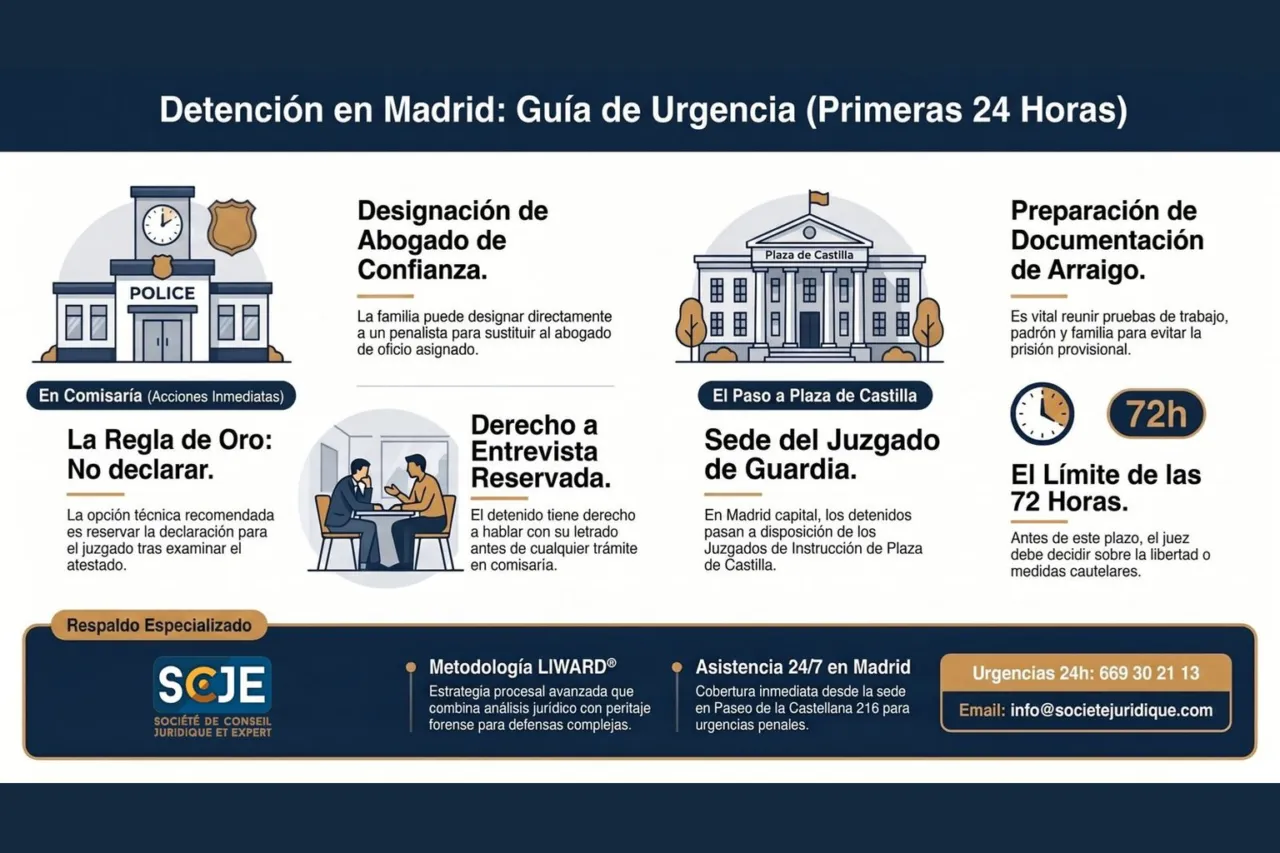
Quick answer. A person arrested in Spain must be released or brought before the duty judge within 72 hours at the latest, and in practice usually much sooner. From the first moment you may remain silent, appoint a lawyer of your choice, have a free interpreter and ask the police to inform your consulate. Do not sign any document or make any statement until your lawyer has arrived and has seen the police file.
Last updated:
Your rights from the moment of arrest
Article 520 of the Spanish Criminal Procedure Act (LECrim) requires the police to inform you, in a language you understand, of the facts you are accused of and the reasons for your arrest. You have the right to remain silent, not to answer some or all of the questions, not to incriminate yourself and not to plead guilty. You may appoint a lawyer of your choice; if you do not, a duty lawyer is assigned, and you may replace that lawyer with a private one at any time.
The lawyer must attend the police station within three hours of being called. Before and after any statement you are entitled to a private interview with your lawyer, and your lawyer may examine the essential elements of the police file needed to challenge the lawfulness of the arrest. You also have the right to have a relative or another person informed of your arrest and whereabouts, to have your consulate informed, to a free interpreter, including for your conversations with your lawyer about the statement, and to be examined by a forensic doctor. If you consider the arrest unlawful, your lawyer can apply for habeas corpus.
Where you will be held and which court hears the case
A person arrested in Alicante, Benidorm or Torrevieja is normally held at the National Police station of that town or at the Guardia Civil post with jurisdiction over the area. When the police investigation is complete, the detainee is released or brought before the duty judge of the Investigation Section of the local Tribunal de Instancia: Alicante, Benidorm or Torrevieja, depending on where the events took place. Offences punishable with more than five years of imprisonment, and appeals, are dealt with by the Audiencia Provincial of Alicante.
What happens before the duty judge
The judge takes your statement as a person under investigation, with your lawyer present, and hears the public prosecutor. The judge may release you without measures, release you with measures such as periodic appearances at court, withdrawal of your passport, a ban on leaving Spain or a restraining order, or, only after a separate hearing at which you are represented, order pre-trial detention.
Many offences committed by visitors, such as drink-driving, minor assaults or thefts caught in the act, are dealt with as fast-track trials. The prosecutor may offer an agreed sentence at the duty court itself; accepting it reduces the sentence by one third, but it is a criminal conviction with a criminal record. That decision should only be taken after your lawyer has reviewed the evidence.
Can I fly home?
If you are released without a ban on leaving Spain, you may return home. You must, however, give an address for service of documents in Spain, or the details of a person who will receive them, and you must attend when summoned. In the abbreviated procedure the trial may take place in your absence if you were duly summoned and the sentence sought does not exceed two years of imprisonment, or six years for penalties of a different nature. If you fail to appear when your presence is required, the court may issue a search and arrest order and, in serious cases, an arrest warrant that can be executed abroad, including in the United Kingdom under the surrender arrangements of the EU and UK Trade and Cooperation Agreement.
What relatives should do
Contact a criminal lawyer as soon as possible and give the full name, date of birth, nationality and place of arrest of the detained person. Locate the passport and any medical information the person may need. Avoid posting about the arrest on social media and do not contact witnesses or the alleged victim. The lawyer will establish where the person is held and will attend the statement.
Frequently asked questions
How long can the police keep me in custody in Spain?
The police may only hold you for the time strictly necessary to investigate the facts, with an absolute limit of 72 hours, after which you must be released or brought before a judge. If the limit is exceeded or the arrest is unlawful, your lawyer can apply for habeas corpus.
Do I have to accept the duty lawyer?
No. You may appoint a lawyer of your choice from the start, and if a duty lawyer has already attended you may replace that lawyer with a private lawyer at any stage of the proceedings.
Will I have an interpreter?
Yes. If you do not speak or understand Spanish you are entitled to a free interpreter at the police station and before the court, including for your conversations with your lawyer about your statement.
Does a fast-track guilty plea leave a criminal record?
Yes. Accepting the agreed sentence at the duty court reduces the penalty by one third, but it is a conviction entered in the Spanish Central Register of Convicted Persons, which is only cancelled after the periods set by Article 136 of the Criminal Code.
Related guides
- Detainee rights in Spain: frequently asked questions
- Fast-track trials and plea agreements in Spain
- Pre-trial detention and bail in Spain
- Criminal defence lawyer in Benidorm
- Criminal defence lawyer in Torrevieja
- English-speaking criminal lawyer in Alicante
Do you need a criminal defence lawyer on the Costa Blanca now? Société Juridique assists detained persons and victims 24 hours a day, in English, from its offices in Alicante, El Campello and Madrid.
This article is informative in nature and does not constitute legal advice. For a specific case, consult a lawyer.
Francisco Javier Martín Porras
Abogado penalista, socio de Société de Conseil Juridique et Expert y creador de la metodología LIWARD®. Dirige la defensa en procedimientos penales de alta complejidad, combinando estrategia procesal con análisis pericial y forense. Conozca al equipo →